
It's (Not) My Party
Maybe it shouldn't be yours either.

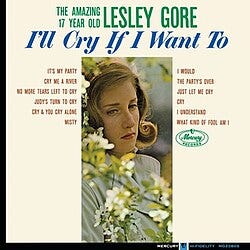
Lesley Gore was only 16 when she recorded It’s My Party, a hit song that continues beyond the title refrain with repetitive words detailing teenage angst: “And I’ll cry if I want to…cry if I want to…cry if I want to. You would cry too, if it happened to you.”
Gore was only 17 by the time the song was a #1 hit on the charts in 1962. The lyrics are based on an actual story: Lyricist Seymour Gottlieb (who later shared it with a buddy who got the official credit) wrote the words after his own daughter pitched a hissy fit—not because of a boy showing up with a rival, as in the song, but when her grandparents were invited to her 16th birthday party. Imagine—one teenager’s snotty response became a song we still recognize 60 years later.
The title came to mind this morning along different lines. More than ten years ago, I made a decision. Neither the Republican party’s platform nor the Democratic party’s platform completely reflected my views. There were elements of each that resonated with me, but there were also elements of each that definitely did not.
So I switched to NPA—No Party Affiliation.
In the state of Florida, where I live, that means I can’t vote in primary elections. Florida is joined by 15 other “closed primary” states. And according to Unite America, “there are just over 16.6 million registered independents who lack the right to vote in primary elections…There are more than 1.8 million voters in closed primary states who are registered with a minor party and are also barred from participating in the major parties’ primaries. A total of 18.4 million registered voters lack a right to participate in taxpayer-funded major party primary elections for congressional and state offices.”
I think we should change that. I think…just hear me out…that one way to claw our way out of the quagmire the country currently finds itself in, is to disrupt the system. Engage in a bit of civil unrest—not necessarily with protests, and certainly not through violence. But…
What if every Democrat who is frustrated by leaders leaning too far to the left…who detect a certain spinelessness at times…who consider that leadership has lost touch with every-day citizens…who see too much emphasis on special interest groups rather than on the economy…who perceive that promises have been broken…said: “You don’t speak for me the way you used to. I want out. I’ll still vote for Democrats when they are the best option for the nation, but I can’t call myself a Democrat any more because of the mess we’re in.”
And…
What if every Republican who is appalled by leaders leaning too far to the right…who observe an unwillingness to compromise…who abhor the lack of civility and adherence to international and Constitutional law that’s splashed across daily headlines… who have had enough of the lies…who are uncomfortable with the overreach and manipulation of various departments…who fear that the balance of powers set forth by our nation’s founders is precariously out of balance…who no longer know who they can trust…who want changes to the system, but measured and compassionate changes…said: “You don’t speak for me the way you used to. I want out. I’ll still vote for Republicans when they are the best option for my community, state and antion, but I can’t call myself a Republican any more because of the mess we’re in.”
A sudden, widespread change of millions of disenfranchised Democrats and Republicans would likely mean the end to an outdated two-party system. It would increase voting. It would require an overhaul of, well, everything. The elephants and the donkeys in charge might actually have to listen to constituents instead of catering to zillionaire donors to their respective political machinery.
It won’t happen, obviously. Things may get a whole lot worse than they are today, and it still is unlikely. Party loyalty is—at least from what I observe on social media and in the news—so firmly entrenched that it my proposal sounds absurd, doesn’t it? I mean, some people identify so strongly to their party that that is who they are and anyone else is just wrong. Even with the millions of us who prefer to stay out of party politics, there are more who cling to rose-colored perceptions of the way they’ve always done things.
(And don’t get me started on the ridiculous name-calling: You can’t be a Christian and be a Democrat! You can’t be a Christian and be a Republican! Demoncrats! MAGAts! Libtards! Cuckservatives! Just stop it. Please. No matter who you are, it’s a bad look.)
There are party-affiliated voters so genuinely passionate about a single issue, they believe they are locked in to the party that agrees with them the most. I know Republicans who abhor MAGA politics but also fear the GOP is the only thing preventing us from reverting to Roe v. Wade. I know Democrats who hated decisions made during the Biden administration but who also fear their party is the only line of defense between the far right and Obergefell v. Hodges.
When Donald Trump ran for President the first go ‘round against Hilary Clinton, I was part of a conversation in the teachers’ lounge at a Catholic school. One of the religion teachers bemoaned the choices, saying that for him, there was no choice. “Moral issues, I’d vote Republican. Social issues, I’d vote Democrat,” he said.
That wasn’t an option. Isn’t an option. But we need more options, better options, one way or another.
In the early years of our nation’s history, the man who got the most votes was elected president. The man who got the second-most votes was the vice-president. Such a system eventually created chaos; the 12th ammendment changing all that was ratified in 1804, but can you imagine the level of cooperation and thoughful compromise such a thing, ideally, might have promoted? A Trump-Harris administration would be unthinkable…but maybe not such a bad idea.
An end to the two-party system—or at least a dramatic shift in that direction— might let in enough light that a candidate could stand for both immigration reform and compassionate avenues to citizenship…could stand for both women’s rights and the rights of the unborn…could celebrate diversity, equity and inclusion while also acknowledging that it isn’t always used justly and efficiently.
(Which reminds me of my senior year in high school, when I was chosen to be a football cheerleader based solely on the color of my skin. The powers-that-be had mandated an equal number of whites and blacks. I was appropriately enthusiastic, but not the most skilled.)
Saying “It’s not my party” is just a suggestion, for what it’s worth. I, for one, can put up with the inability to vote in primaries for now, if it means distancing myself, at least in measure, from party behavior and values that no longer speak for who I am. When I am allowed to enter the voting booth, I will continue to vote for the person I believe to have the most integrity, honesty, open-minded reason and intelligence…regardless of his or her party affiliation.